To find a good lawyer, start by naming your legal problem. Then build a shortlist of 2 or 3 lawyers who often handle that type of case. Check each lawyer’s license on the state bar’s website, then schedule a consultation. Hire the one who explains your options plainly and puts the fee in writing.
Key takeaways
- Match the lawyer to your problem. Experience with cases like yours matters more than total years in practice.
- Check the license yourself on the state bar or licensing agency’s website. It takes a few minutes.
- Treat the first consultation as a job interview, and ask who will actually work on your file.
- Get the scope of the work and the fee terms in writing before anything starts.
How to find the right lawyer in 7 steps
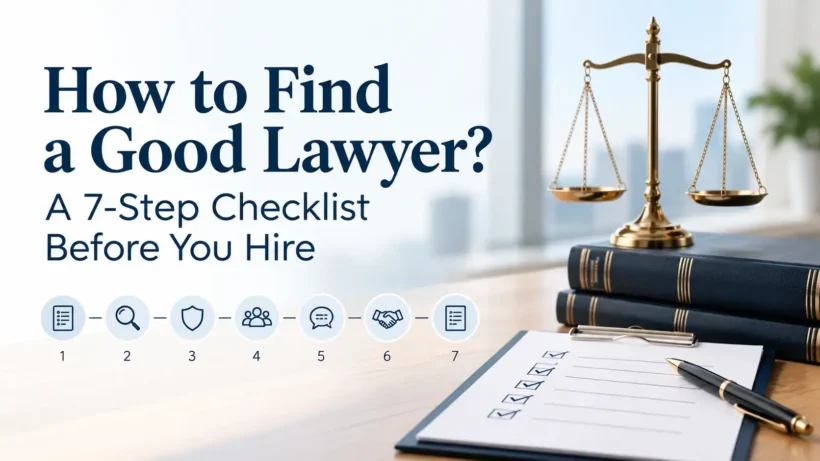
Most people look for a lawyer once or twice in their life, usually when something has already gone wrong. The steps below keep the process short.
Step 1: Name the type of legal problem you have
Lawyers work in practice areas. Someone who drafts wills all day is not the person to defend a DUI charge, even if both have the same license.
You don’t need the legal term. Describe what happened in one line, then match it to the area to search:
| What happened | Practice area to search |
|---|---|
| You were hurt in a crash or a fall | Personal injury (or car accident, truck accident) |
| You were arrested or charged | Criminal defense (or DUI) |
| You’re separating or need a custody order | Divorce and family law |
| Your employer fired you, harassed you or didn’t pay you | Employment law |
| You need a will, a trust or help with an estate | Estate planning and probate |
| Your debts are out of control | Bankruptcy |
| You need a visa, a green card or help with removal | Immigration |
Some problems touch several areas, like a small business owner with a lease dispute and an unpaid invoice. A general practice firm can handle a mix like that, or refer you to the right specialist. To see what those firms look like, browse general practice law firms in the US.
Step 2: Build a shortlist from sources you can check
Aim for two or three names. More than that and you’ll spend weeks on consultations. Good places to start:
- People you trust who had the same kind of problem. A friend’s great divorce lawyer may know nothing about your injury case, but they can usually name someone who does.
- A lawyer you already know. Lawyers tend to know who is good in other areas.
- Your state or local bar’s lawyer referral service. Ask how lawyers get on its list. Some services screen for experience in the practice area. Others accept any lawyer in good standing.
- Legal aid, if money is tight. The CFPB’s guide to finding an attorney points to legal aid offices, LawHelp.org and bar referral services.
- Online lawyer directories, as long as you know how to read them. On OnToplist, you can search for lawyers by practice area and location.
That last one needs a warning, and I’ll give it as someone who runs a lawyer directory. The first name on a directory page is not always the “best” one. Many directories sell a top spot. On OnToplist, we label sponsored placements as advertising and place them above the ranked list. Our law firm ranking methodology explains how we order the rest of the list. Other sites handle this differently, so look for a “sponsored,” “featured” or “premium” label before you trust the order.
A directory is useful for one thing: getting names to check. Say you were hurt in a crash in Ohio. A page that lets you compare personal injury lawyers in Cleveland gives you firms, practice areas, and contact details in one place. If you’re in Illinois, the list of Chicago personal injury law firms does the same. Anywhere else, start from the national personal injury lawyer directory and pick your state. Steps 3 to 7 are how you narrow the list down.
Step 3: Check the license (it takes a few minutes)
Check that the lawyer is authorized to practice in the state and court where your case will be handled. Federal courts and out-of-state lawyers have their own admission rules, so ask if your case crosses state lines. Each state has a licensing body, usually the state bar or the state’s highest court, and most offer a free online attorney search. The CFPB recommends checking that the lawyer is in good standing and has no disciplinary record.
When you pull up the profile, check four things:
- Status. You want “active” or “in good standing.” Labels like inactive, suspended or disbarred mean the lawyer can’t take your case in that state.
- Admission date. It tells you how long they’ve been licensed there.
- Public discipline. Many states show orders on the profile or link to them. Read what happened and when.
- Name and address. They should match the website and the office you’re dealing with.
One old, minor disciplinary matter isn’t necessarily a dealbreaker. A recent suspension or other serious discipline deserves a much closer look. Ask the lawyer directly and see how they respond.
When we review law firms for OnToplist, we keep the firm off the list if we can’t confirm a license with the state bar. That’s a fair rule for you too.
Step 4: Match their experience to your case
Years in practice is a weak signal on its own.
Twenty years of practice means little if only a few of those years involved cases like yours.
Look for depth in your specific type of problem. These questions sort that out quickly:
- What share of their work is cases like yours?
- If you’re an individual bringing a claim, do they regularly represent people in your position, or mostly the other side, like insurers or employers?
- Do they handle cases in your county or court?
- If your case goes to trial, have they tried similar cases, or do they settle everything?
Watch the word “specialist.” Under the American Bar Association’s model rules, a lawyer shouldn’t claim to be a certified specialist unless a state-approved or ABA-accredited body certified them. States handle this rule differently. If a website says “board certified,” ask which organization did the certifying.
Step 5: Read reviews and ratings with care
Google reviews help most when you read them for patterns. Look for comments about communication, fee transparency, and who handled the case. A few negative reviews don’t tell you much on their own. A burst of short five-star reviews posted in the same week is worth a second look.
Badges need more caution. Super Lawyers, Best Lawyers, Martindale-Hubbell and Avvo all use different criteria, and some of these publishers also sell advertising to the lawyers they rate. A badge means little until you know how it was awarded. Read the publisher’s own selection page before giving it any weight.
Step 6: Treat the consultation like a job interview
Many lawyers offer a free first meeting, but not all do. Ask about the cost when you book. Before you go, prepare three things:
- A short written timeline of what happened, with dates
- Copies of key documents: letters, contracts, police or medical reports, court papers
- Your list of questions (use the table below)
You may worry about sharing details with a lawyer you haven’t hired. What you share in a consultation may be protected by professional rules on prospective clients, even if you never hire that lawyer. The exact rules vary by state. If confidentiality worries you, ask before you share sensitive details.
Here are the questions worth asking, and what the answers tell you:
| Ask this | Good sign | Red flag |
|---|---|---|
| How many cases like mine have you handled recently? | A specific number or examples | “We handle everything” |
| Do you have room to take my case right now? | An honest answer about their caseload | A yes, then weeks of silence |
| Who will actually work on my case? | Names the lawyer and staff, and who you’ll talk to | Can’t say, or a partner meets you and then disappears |
| What are the weak spots in my case? | Names real risks | Only good news |
| What outcomes are realistic? | A range, and what it depends on | A guaranteed win or dollar figure |
| How will you keep me updated, and how fast do you reply? | A clear method and timeframe | “We’ll be in touch” |
| How do you charge, and what costs are extra? | Explains the fee and costs, offers a written agreement | Dodges the question or pushes you to sign today |
Pay attention to how the meeting feels, too. You should be able to ask basic questions without feeling rushed. You’ll be sharing personal details with this person for months, sometimes years.
Step 7: Get the fee agreement in writing
Lawyers usually charge in one of four ways:
- Contingency fee. The lawyer takes a percentage of what you recover, and usually nothing if you lose. This is common in injury cases.
- Hourly. You pay for time, often billed in small increments.
- Flat fee. One price for a defined task, like a simple will or an uncontested filing.
- Retainer. An upfront deposit the lawyer bills against.
The ABA Model Rules provide a useful framework, but each state’s rules can differ. ABA Model Rule 1.5 says a lawyer should explain the scope of the work and the fee, preferably in writing. For contingency fees, Rule 1.5 requires a written agreement. It must explain how the percentage is calculated and how expenses are handled. The model rule also bars contingency fees in criminal defense. It bars them in divorce cases too, when payment depends on getting the divorce or on the support or property awarded. Your state’s version may differ, so read the agreement closely.
Before you sign, get answers to these:
- Are case costs, like filing fees, records and expert witnesses, taken out before or after the lawyer’s percentage?
- Who pays those costs if you lose?
- How often will you be billed, and will the bills be itemized?
- What happens to unused retainer money if the case ends early?
Red flags worth taking seriously
Any of these can be a reason to keep looking, depending on the circumstances:
- The lawyer guarantees a win or a specific dollar amount. No lawyer can honestly promise a result.
- They push you to sign at the first meeting.
- They won’t put the fee or the scope of work in writing.
- They can’t say who will handle your file day to day.
- Their license isn’t active, or there’s recent discipline they won’t discuss.
- They claim to be a “certified specialist” but can’t name the certifying body.
- They ignore your calls before you’ve even hired them. It rarely gets better after you sign.
How to choose between two good lawyers
Sometimes two lawyers both pass every check. Compare them on what will matter over the life of the case:
| Factor | What to compare |
|---|---|
| Experience | Who handles cases like yours more often? |
| Communication | Who explained things more clearly? |
| Honesty | Who gave you the more realistic assessment, including the risks? |
| Fees | Whose fee structure fits your budget and your case? |
| Capacity | Who can actually give your case attention right now? |
| Firm size | A large firm brings more resources. A small firm or solo lawyer often means you deal with the same person throughout. |
| Comfort | Who would you rather call with bad news? |
There is rarely one objectively best lawyer for a case. If both are qualified, pick the one you trust to tell you the truth when it’s inconvenient.
Your quick checklist before you hire
Run through this before you sign anything:
- [ ] I know which practice area my problem falls under
- [ ] I have two or three names from sources I can check
- [ ] Each license is active, and I’ve read any discipline history
- [ ] The lawyer handles cases like mine regularly
- [ ] I’ve read reviews for patterns, not just the star rating
- [ ] I’ve met at least one lawyer and asked who will handle my file
- [ ] I know how the fee works and what costs are extra
- [ ] The fee agreement is in writing
Frequently asked questions
How do I know if a lawyer is good?
A good lawyer has an active license, handles cases like yours regularly and gives you a realistic view of your case, including the risks. They explain fees in writing and return calls in a reasonable time. Reviews and badges help, but they come after those basics.
Should I talk to more than one lawyer?
For anything serious, yes. Meeting two lawyers shows you how differently they read the same facts. It also makes unrealistic promises easier to spot.
What if I can’t afford a lawyer?
Look at legal aid first. Eligibility usually depends on income and the type of case, and LawHelp.org lists programs by state. Some bar referral services offer reduced-fee consultations. In injury cases, contingency fees mean you usually pay nothing up front.
Is a free consultation really free?
Often it is, but confirm when you book. Some lawyers charge for the first meeting, especially in family and business matters. A free consultation also doesn’t commit you to hiring that lawyer.
Conclusion
Finding a good lawyer mostly comes down to checking the right things in the right order. Name the problem, build a short list, verify the license, and test each lawyer in a consultation. Then get the fee in writing. If you follow those steps, you’ll make fewer of the most common hiring mistakes.
This article is general information, not legal advice. Laws and court rules differ by state, and every case turns on its own facts. Talk to a licensed attorney in your state about your situation.