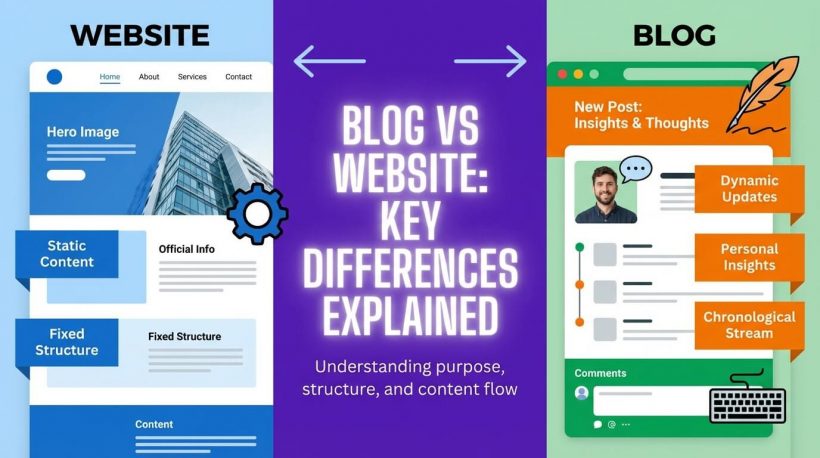
Trying to decide between starting a blog or building a website? You’re not alone. These two terms get thrown around like they’re the same thing—but they’re not.
Understanding the difference can save you months of frustration and help you pick the right platform for your goals.
Here’s what you need to know.
Key Takeaways
- Blogs feature regularly updated content in reverse chronological order; websites contain static pages that rarely change
- Choose a blog if you want to share ideas, build authority, and engage readers through comments
- Choose a website if you need to showcase services, sell products, or display unchanging business information
- Most successful businesses combine both—a static website with a blog section for SEO and audience engagement
What Is a Blog?
A blog is a type of website focused on regularly published content. Posts appear in reverse chronological order—newest first.
Think of it as an online journal or magazine. You write articles, hit publish, and your audience reads them.
The word “blog” comes from “weblog”—essentially a log of content published on the web.
Blogs thrive on fresh content. Most successful bloggers publish at least once a week, sometimes daily.
Each post typically covers a specific topic within your niche. A food blogger might write about pasta recipes. A marketing blog might cover SEO strategies.
The key feature? Interaction. Readers can leave comments, ask questions, and share their opinions. This two-way communication builds community and keeps people coming back.
Common Blog Types
- Personal blogs — Share stories, experiences, and opinions
- Business blogs — Educate customers and drive organic traffic
- Niche blogs — Cover specific topics like fitness, travel, or SEO
- News blogs — Report on industry developments and current events
If you’re serious about how to write a blog that attracts readers, consistency matters more than perfection. Your first post won’t be your best—and that’s okay.
What Is a Website?
A website is a collection of connected web pages under a single domain name. Unlike blogs, websites focus on static content that doesn’t need frequent updates.
Your “About” page probably looks the same as it did six months ago. Your “Services” page only changes when you add new offerings.
That’s the core difference.
Websites work like digital brochures. They present information about who you are, what you do, and how visitors can contact you.
A typical business website includes pages like:
- Homepage
- About Us
- Services or Products
- Contact
- Testimonials
These pages give visitors everything they need to understand your business—without requiring regular content production.
Websites prioritize structure over freshness. Information is organized by category and topic, not by date.
Common Website Types
Websites serve different purposes depending on your goals. Here’s how they break down:
| Website Type | Primary Purpose | Example |
|---|---|---|
| Business/Corporate | Showcase company info and services | Law firm websites |
| eCommerce | Sell products online | Online stores |
| Portfolio | Display creative work | Designer portfolios |
| Landing Page | Convert visitors to leads | Campaign pages |
| Educational | Provide learning resources | Online courses |
Getting listed in a reputable business directory helps both websites and blogs improve visibility and build credibility with search engines.
Key Differences Between Blog and Website
Now, let’s dig into what actually sets these two platforms apart.
1. Content Type and Structure
Blogs organize content chronologically. Your latest post sits at the top. Older content moves down.
The structure is simple: a feed of articles that readers scroll through or search by category.
Websites organize content hierarchically. Pages connect through navigation menus. Visitors click through sections to find what they need.
There’s no “latest” content fighting for attention. Each page has a permanent home.
2. Update Frequency
This is where the biggest practical difference shows up.
Blogs demand regular updates. Skip a few weeks, and your audience notices. Search engines notice too.
Successful blogs typically publish 1-4 posts per week. That’s 50-200 pieces of content per year.
Websites can sit untouched for months without hurting your business. You update them when something changes—new products, updated pricing, fresh testimonials.
Here’s how the workload compares:
| Factor | Blog | Website |
|---|---|---|
| Content creation | Ongoing (weekly/monthly) | One-time with occasional updates |
| Time investment | High | Low to medium |
| Maintenance | Regular | Minimal |
| Content volume | High (100+ posts/year) | Low (5-20 pages total) |
3. Purpose and Goals
Your goals should drive your choice.
Choose a blog when you want to:
- Build authority in your niche
- Drive organic search traffic
- Engage with readers through comments
- Share knowledge and opinions regularly
- Create content that compounds over time
Choose a website when you want to:
- Present your business professionally
- Showcase products or services
- Provide contact and location information
- Build credibility with a polished online presence
- Convert visitors into customers or clients
Many businesses benefit from both. Your website handles the “who we are” part. Your blog handles “here’s what we know.”
4. Writing Style and Tone
Blogs tend to be conversational. You’re talking to someone, not at them.
Personal opinions matter. Stories engage readers. First-person perspective (“I” and “we”) feels natural.
Websites lean more formal and professional. The copy focuses on benefits and calls to action. The third-person perspective often works better.
Think about the difference between these two approaches:
Blog style: “I tested five different email marketing tools last month. Here’s what happened—and which one I actually kept using.”
Website style: “Our email marketing solutions help businesses increase open rates by 40% and drive measurable results.”
Same topic. Different approach.
5. Monetization Methods
Both platforms can generate income—but through different strategies.
Blog monetization options:
- Display advertising (Google AdSense, Mediavine)
- Affiliate marketing (commissions from product recommendations)
- Sponsored posts and brand partnerships
- Digital products (ebooks, courses)
- Membership or subscription content
Website monetization options:
- Direct product or service sales
- Lead generation for high-ticket offerings
- Consulting or booking services
- eCommerce transactions
- Service packages or retainers
The key difference? Blogs monetize content. Websites monetize offerings.
Understanding backlinks in digital marketing helps both blogs and websites build authority and drive revenue-generating traffic.
6. SEO Benefits
Search engines love fresh content. That gives blogs a natural advantage.
Every new blog post creates another page for Google to index. More pages mean more chances to rank for different keywords.
Companies with blogs get 55% more website visitors than those without, according to HubSpot research.
But websites aren’t SEO dead zones. Static pages can rank well for high-intent keywords—especially service and product pages.
The smart move? Use both.
Your website targets commercial keywords (“personal injury lawyer Chicago”). Your blog targets informational keywords (“what to do after a car accident”).
Following on-page SEO techniques helps both blogs and websites rank higher in search results.
When Should You Choose a Blog?
A blog makes sense when content is your main asset.
Start a blog if you:
- Want to share expertise and build thought leadership
- Have time to create content consistently
- Plan to monetize through ads, affiliates, or digital products
- Need organic traffic from search engines
- Enjoy writing and connecting with readers
Bloggers who succeed treat publishing like a habit, not a hobby. If you’re wondering how to blog consistently, start with a realistic schedule you can actually maintain.
One quality post per week beats five rushed posts that no one wants to read.
Pro tip: Pick a niche you can write about for years, not months. Passion fades—choose a topic with staying power.
When Should You Choose a Website?
A website works best when you have something specific to offer—products, services, or information that doesn’t need constant updates.
Build a website if you:
- Run a service-based business (law firm, agency, consultancy)
- Sell physical or digital products
- Need a professional online presence without ongoing content demands
- Want a central hub for your contact info and credentials
- Prefer a “set it and forget it” approach
Local businesses especially benefit from websites. A plumber doesn’t need to blog weekly—they need a site that shows up when someone searches “plumber near me.”
For local visibility, local SEO for small businesses explains how to optimize your website for geographic searches.
Can You Have Both? (Yes—And You Should)
Here’s the truth most people miss: you don’t have to choose.
The most effective online presence combines a professional website with an active blog section.
Your website handles the commercial heavy lifting. It shows visitors what you offer and how to hire you.
Your blog drives traffic and builds authority. It answers questions your potential customers are already searching for.
Think of it this way:
| Component | Function | Traffic Type |
|---|---|---|
| Website pages | Convert visitors to customers | Direct and referral |
| Blog posts | Attract new visitors from search | Organic search |
Together, they create a flywheel. Blog posts bring people in. Website pages close the deal.
Adding your blog to a quality web directory can accelerate this process by building backlinks and increasing discoverability.
How to Structure a Combined Site
Most platforms make this easy. You create your main website pages, then add a “Blog” section.
WordPress handles this by default. Website builders like Wix, Squarespace, and Webflow offer built-in blog features.
The key is keeping them connected:
- Link from blog posts to relevant service pages
- Add blog post previews to your homepage
- Include your blog in the main navigation menu
- Use consistent branding across both sections
Following internal links SEO best practices helps search engines understand how your content connects and improves rankings across your entire site.
Frequently Asked Questions
Is a blog better than a website for SEO?
Blogs have an SEO advantage because they generate fresh content regularly. Each new post creates another ranking opportunity. But websites can rank well too—especially for commercial keywords. The best SEO strategy combines both static website pages for services and products, plus blog posts for informational queries.
Can I turn my blog into a website?
Absolutely. Most blogging platforms let you add static pages alongside your blog posts. You can create About, Contact, and Services pages while keeping your blog active. It’s just a matter of expanding your site structure.
Do I need technical skills to start a blog or website?
Not anymore. Platforms like WordPress, Wix, Squarespace, and Webflow make it possible for beginners to build both blogs and websites. You can have a professional-looking site live within a day—no coding required.
How much does it cost to start a blog vs a website?
Costs are similar for both. You’ll need a domain name ($10-15/year) and hosting ($3-30/month). Free options exist but come with limitations like ads and unprofessional URLs. Budget around $100-200 for your first year with a quality setup.
Which is easier to monetize—a blog or a website?
It depends on your business model. Blogs work better for ad revenue and affiliate income. Websites work better for direct product or service sales. Both can be profitable—the key is matching your monetization strategy to your platform.
How often should I update my blog vs my website?
Blogs need regular updates—weekly or biweekly is standard. Websites only need updates when information changes (new services, updated contact info, fresh testimonials). The maintenance difference is significant.
Conclusion
The blog vs website debate isn’t really either/or—it’s about matching your platform to your goals.
If you want to share ideas, build an audience, and create content that compounds over time, start with a blog. If you need a professional home base for your business with minimal ongoing work, build a website.
The smartest approach? Do both. Use your website to convert visitors and your blog to attract them.
Whatever you choose, the important thing is to start. Your first version won’t be perfect. It doesn’t need to be.
Pick your path, publish something, and improve as you go.