The free vs paid directories question comes down to one thing: does anyone actually use the directory? A free listing on a site your customers visit beats a paid listing on one they don’t. Paying buys profile features, placement, and faster review. It doesn’t buy SEO value. Judge each directory on its audience and its traffic. Check the price last.
Key Takeaways
- Paying for a listing does not make the link count for more. Google’s spam policies treat paid links that pass ranking credit as link spam.
- Judge a directory by whether real people use it, not by a Domain Authority score.
- Before you pay, find out what happens to your listing when you stop paying. Most directories won’t volunteer that answer.
- Track referral traffic and leads for a reasonable period, then review whether the listing justifies its cost.
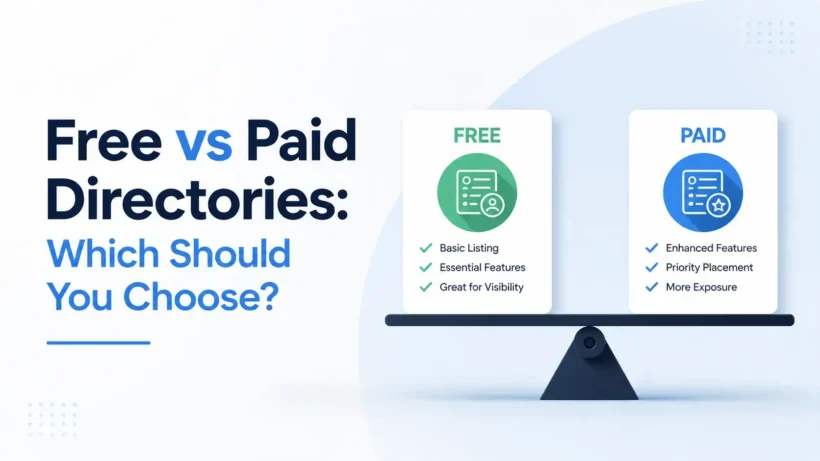
What free vs paid directories actually get you
A directory listing is a profile page for your business. It includes your name, website, phone number, service area, category, description, hours, and sometimes photos and reviews.
That page has two audiences. One is the person comparing three roofers before making a call. The other is a search engine trying to confirm your business is real and that your details match everywhere else.
Free and paid tiers on the same directory usually serve both audiences with the same page. What changes is how much of the page you control.
| What you get | Free Directory | Paid Directory |
|---|---|---|
| Cost | $0 | Varies by directory |
| Name, website, phone, category | Yes | Yes |
| Photos, longer description, extra categories | Sometimes | More often |
| Featured or priority placement | Rare | Common |
| Analytics on views and clicks | Rare | More often |
| Review speed | Days or weeks | Often minutes |
| Editorial vetting | Varies by directory | Varies by directory |
| Referral traffic | Depends on the directory | Depends on the directory |
| SEO value | Depends on the directory | Depends on the directory |
Note the last two rows. They’re identical on purpose.
Directory pricing often changes what you get rather than the underlying SEO value. Paid tiers may add features such as analytics, additional profile information, social links, maps, or faster review.
The part of a free directory people underrate
Google builds its picture of your business from a lot of places at once: what you publish, what you tell it directly, third-party data providers, and other listings around the web. It’s cross-referencing. When your phone number reads one way on your site and another way on four directories, you’ve handed it conflicting information about a business it’s trying to describe accurately.
The cost isn’t abstract. A wrong number means the call doesn’t connect. An old address means someone is driving to a unit you left two years ago. Those are lost customers before any ranking question comes into it.
This is why keeping your NAP details consistent does more for a local business than any paid upgrade. It also costs nothing, which is the awkward part for anyone selling directory packages. Fixing five mismatched free profiles is usually a better use of an afternoon than buying a sixth listing.
Why paying doesn’t buy SEO value
Google’s spam policies for web search name buying or selling links for ranking purposes as link spam, and list low-quality directory links as an example. Paid placements are fine when they carry rel="sponsored" or rel="nofollow".
Read that together and the conclusion is uncomfortable for a lot of directory sales pitches. A site selling you a followed link as a ranking product is selling something Google asks it not to sell.
If a directory’s main selling point is the backlink, be cautious.
The reverse myth is also outdated. Since 2019, Google has treated nofollow, ugc, and sponsored as hints rather than hard directives. A nofollow listing isn’t a wasted listing. It still sends clicks, still shows up when someone searches your brand name, and still puts your phone number in front of a buyer.
How to judge a directory before you pay
Skip the authority metrics. Domain Authority is a third-party score, not something Google uses. A relevant directory with an active audience can be more valuable than a larger general directory that receives little relevant traffic. Here’s what I’d check first. It’s the short version of a fuller process for sizing up an online directory.
- Search for it the way a customer would. Type “best roofing companies Denver” or “personal injury lawyers directory” into Google. If the directory never surfaces for the searches your buyers run, its listing pages can’t send you anyone.
- Now search a competitor’s business name. If their profile ranks on page one, that shows the directory’s individual listings can get search visibility. If only the directory’s homepage ever ranks, the interior pages are dead weight.
- Look for signs of life. Recent reviews with dates, listings updated this year, owners replying to comments. A directory full of profiles last touched in 2019 is a parking lot.
- Match the directory to what you sell. A narrow industry directory usually outperforms a big general one because its visitors have already decided what they’re shopping for.
- Then read what the fee actually covers: placement, photo count, categories, analytics, whether you can edit the profile yourself, and the renewal terms.
Ask what happens when you stop paying
This is the question almost nobody asks, and it separates marketing spend from a subscription trap. Email support before you buy and get the answers in writing:
- Does the listing disappear entirely, or drop back to a free tier?
- Does the link to your site survive, or get stripped out?
- Do the reviews you collected stay on the profile, or vanish with the plan?
- Does your position in the category reset to the bottom?
- Is renewal automatic, and what’s the cancellation window?
A directory that answers those clearly is one you can plan around. Vague answers tell you the pricing depends on you not paying attention.
Then do the math. Divide the annual fee by what an average customer is worth to you. A $300 legal listing that needs one $3,000 case per year to break even is an easy call. A $300 listing that needs 40 sales at $12 profit each is not.
Last step: tag the listing link with UTM parameters before you submit it, then check the numbers at 90 days. A basic UTM tag in GA4 tells you whether anyone clicked.
When a paid listing is worth it, and when to walk away
Pay when you can finish this sentence: “I’m paying because ___.” If the blank fills with something concrete, go ahead.
Good reasons look like this:
- Your customers browse this directory before they choose a vendor.
- It ranks for the exact searches you want to appear in.
- Your competitors are already listed and you’re the one missing.
- The paid tier unlocks something real, like a map pin, a leads inbox, or review collection.
- You can measure the result.
The bad reasons are easier to spot once you know the tells. The pitch leads with the backlink or the domain metrics. Anyone who pays gets accepted. Listings sit there with no reviews and no recent activity; you can’t find a single category page from the directory in Google, and you can’t track a click. Any one of those is enough to close the tab.
Two mistakes waste more directory budget than anything else. The first is buying by Domain Authority, which measures nothing about whether a human will ever see your profile. The second is buying volume, on the theory that fifty listings must beat five. They don’t, and mass submission packages are exactly the footprint Google’s link-spam policy describes.
| Business type | Where to start |
|---|---|
| New local business | Free listings on the major platforms first |
| Local service business | Free listings, plus one relevant home-service platform |
| Law firm | Legal directories like Avvo or Justia, plus local listings |
| SaaS or software | Software review sites like G2 or Capterra |
| Established multi-location business | Free coverage everywhere, paid where you compete hardest |
Whatever your category, the free work comes first because it’s free, not because it’s a lesser tier. Claim the free business listing sites worth your time, fill out every profile completely, and get your Google Business Profile in order before you spend a dollar elsewhere. A half-finished free profile is a wasted asset, and no paid listing fixes it.
FAQ
Are paid business directories worth it?
Sometimes. A paid listing is worth it when the directory has an audience that matches your customers, and the upgrade gives you measurable visibility or features. It’s not worth it when all you’re buying is a link.
Do paid directory listings improve Google rankings?
Not because they’re paid. Google’s spam policies specifically cover buying links for ranking purposes, so a directory selling ranking credit is offering you the risky version. Any ranking benefit comes from the directory being genuinely good, not from what it charged you.
How many business directories should I list my business on?
There’s no target number, and chasing one is how people end up with junk listings. Pick the directories your customers use and where your competitors appear, then keep every profile accurate. How many listings you actually need depends more on your industry than any benchmark.
Conclusion
The free vs paid directories decision isn’t really about price. Free doesn’t mean low value, and paid doesn’t mean better SEO. Choose directories by audience, relevance, and what you can measure, then let price decide the order you tackle them. Claim the free directory profiles you can get today. When a directory genuinely fits your industry, list your business and treat the profile like a landing page rather than a checkbox.