A brand mention in SEO is every appearance of your business name online, with or without a link. Search engines read them as trust signals. AI tools like ChatGPT and Google’s AI Overviews use them to decide which brands to recommend. If you only chase backlinks, you’re feeding half the system.
Key Takeaways
- A brand mention is any reference to your company name online, linked or not
- Google’s Panda patent treats unlinked mentions as “implied links”, a documented ranking input
- AI assistants recommend brands they see named consistently across trusted sources
- Directory listings generate mentions on several platforms at once, and aggregators multiply the count
- Not every unlinked mention is worth converting into a backlink; some do more good untouched
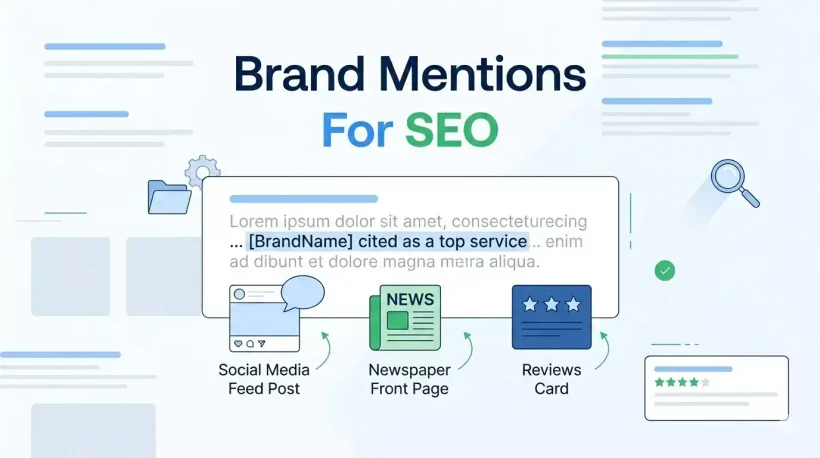
What Is a Brand Mention in SEO?
A brand mention is any time your business name appears on the web. That covers news articles, blog posts, reviews, forum threads, podcasts, social posts, and directory listings.
In 2026, three types are worth separating:
- Linked mentions. Your name is a clickable link pointing to your site, a classic backlink.
- Unlinked mentions. Your name appears in plain text with no hyperlink.
- AI mentions. An AI assistant names your brand in a generated answer, with or without a citation.
The first two have been around as long as SEO itself. The third is new, and it’s the reason this topic got hot again. When ChatGPT or Google’s AI Mode recommends “the best HVAC company in Denver”, that answer is built from the mention patterns those systems found across the web.
Why Brand Mentions Matter for Rankings and AI Search
Google’s Panda patent describes “implied links”: references to a brand that carry weight without a hyperlink. If your name keeps showing up on credible sites, Google counts those references as votes. Customers behave the same way. More than 70% of consumers say they trust brand mentions over traditional ads, according to HubSpot data.
Three mechanisms do the work:
- Entity recognition. Google keeps a knowledge graph of businesses, people, and places. Consistent mentions next to your industry terms and city teach Google what you do and where.
- Authority signals. A mention on an established, indexed site strengthens your E-E-A-T profile, the trust assessment behind modern rankings.
- AI training and retrieval. Language models learn brand associations from the text they crawl. Brands named often, in the right context, surface in Google’s AI Overviews and chatbot answers.
The cost of ignoring this is concrete. A competitor with fewer backlinks but a denser mention footprint can beat you in AI answers, where two or three brands get named instead of ten blue links.
Google has always been good at counting votes. It no longer needs a hyperlink to register one.
How to Earn Brand Mentions at Scale
Here’s what most brand mention guides skip: directories are the cheapest reliable source of quality mentions. We watch the mechanics daily from the operator side at OnToplist, and one listing does more work than people expect.
When your listing goes live on an established directory, four things happen:
- Your name lands on an indexed, trusted page tied to your category and city
- Your NAP data (name, address, phone) reinforces your entity footprint
- Aggregator sites that pull from directories republish the listing, which multiplies your mention count with no extra effort
- People browsing the category see your name even when they weren’t searching for you
From the reviewer’s side, the listings that spread furthest share one trait: NAP details that match everywhere. Aggregators and AI crawlers cross-check names against other sources. A business listed as “Smith & Sons LLC” in one place and “Smith and Sons Plumbing” in another splits its own signal. Our guide to building local citations shows how to keep those details aligned.
Niche relevance beats raw volume. A law firm gains more from one legal directory in its practice area than from ten unrelated general lists.
Beyond directories, a few tactics earn mentions on repeat:
- Reviews. Ask happy customers to review you on Google, Trustpilot, or G2. Reviews are mentions with sentiment attached, and your Google Business Profile reviews feed local rankings directly.
- Original data. Publish one small survey or dataset per year. Writers cite numbers, and citing means naming you.
- Community answers. Answer real questions on Reddit and niche forums where your customers compare options. AI assistants cite these threads constantly.
- Digital PR. Pitch one specific story or expert quote to a trade publication your buyers actually read.
How to Track Brand Mentions (Plus a Free 15-Minute AI Check)
Start free. Google Alerts catches new web mentions of your name, common misspellings, and key people. Google Search Console shows whether branded search impressions are growing, which is the clearest sign your mention footprint is working.
Paid platforms like Ahrefs Content Explorer and Semrush Brand Monitoring add filters for unlinked mentions and source authority. They earn their fee once you run outreach at volume. Before that, skip them.
For AI visibility, here’s a monthly routine that costs nothing and takes 15 minutes:
- Write down 5 to 10 prompts your customers would ask, like “best [service] in [city]” or “is [your brand] legit”
- Run each prompt in ChatGPT, Gemini, and Google’s AI Mode
- Note three things per prompt: does your brand appear, is the description accurate, and which competitors show up
- Log the results in a spreadsheet and repeat next month
Two rounds of this tell you more about your AI presence than most dashboards. When competitors keep appearing where you don’t, check which sources the AI cites. Those pages are your next mention targets.
When to Convert Unlinked Mentions Into Backlinks (and When to Skip It)
Outreach to a site that already named you converts far better than cold link begging. They know who you are. But not every mention deserves an email.
A simple rule: convert when the page is relevant to your niche and gets real traffic. Otherwise, leave it.
- Worth converting: blog posts, news articles, and industry roundups in your niche with decent authority
- Leave alone: major-publication mentions (already valuable as they are), community threads (asking looks spammy), and thin pages nobody visits
For the ones worth converting, keep the email to three or four sentences. Point out the mention, offer the exact URL, and follow up once after a week. Directory aggregators are a quiet source of these wins: sites that republish listings often strip the link, and most restore it on request.
Fold this into a wider plan for earning quality backlinks built on relevance rather than volume.
FAQ
Are brand mentions a confirmed Google ranking factor?
Google has never listed them as a direct factor. Its Panda patent describes implied links, and its systems build entity profiles from unlinked references. Treat mentions as an input to authority, not a switch that moves rankings on its own.
Do AI tools like ChatGPT use brand mentions?
Yes. Language models learn which brands belong to which topics from mention patterns in training data and live retrieval. Consistent, accurate mentions across trusted sources raise your odds of being recommended.
Conclusion
Brand mentions reward a visible, consistent presence, not just a big backlink count. Start with clean directory listings to anchor your entity. Add reviews plus one or two mention tactics you can sustain. Then run the monthly AI check and convert only the unlinked mentions that earn it.