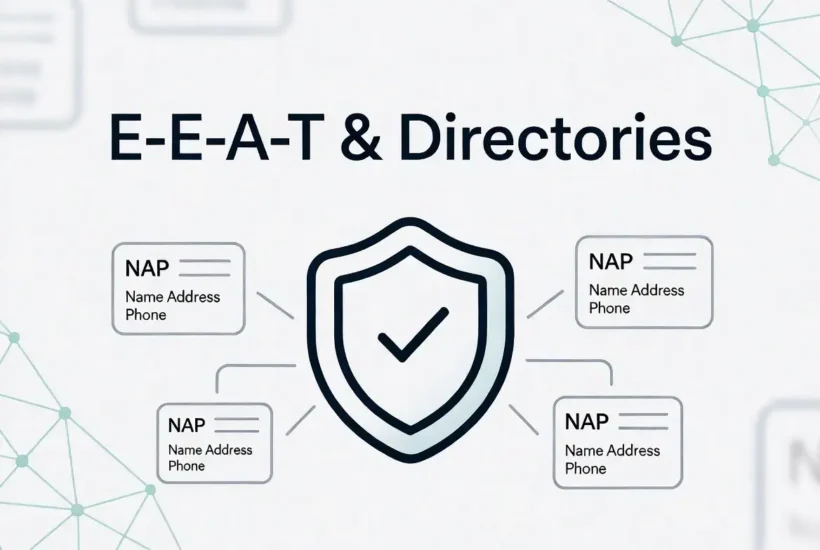
Directory listings build E-E-A-T trust signals by confirming your business is real, consistent, and recognized on sites Google already trusts. Each accurate listing works as a citation. It repeats your name, address, and phone number across the web. When dozens of reputable directories agree on those details, Google reads it as proof of authority and trust. That proof covers two of the four pillars behind E-E-A-T.
Key Takeaways
- A directory listing is a citation: a mention of your business name, address, and phone (NAP) that Google uses to confirm you exist.
- Consistency is the signal. Matching NAP details across trusted directories builds the authority and trust in E-E-A-T.
- Quality beats volume. A handful of high-authority, relevant directories outperform hundreds of spammy ones.
- Listings now feed AI search too, since tools like Google’s AI Overviews pull from verified, structured business data.
What E-E-A-T trust signals are, and where directories fit
E-E-A-T stands for Experience, Expertise, Authoritativeness, and Trustworthiness. Google’s search quality raters use it to judge how reliable a page or business is. It is not a single score you can look up. It is a framework that Google’s systems approximate through measurable signals.
Trust signals are the clues that feed that framework. They include consistent business details, reviews, secure HTTPS, clear contact info, and mentions on reputable sites.
Directory listings sit right in the middle of this. In SEO, a listing is called a citation, and each one is another source confirming that your business is who it says it is.
Adirectorylisting is a vote of confidence Google can verify. The more reputable sites that confirm your details, the more trust you earn.
Google’s 2025 Search Quality Rater Guidelines call trust the most important member of the E-E-A-T family. Without it, experience and expertise count for little. Online listings build that trust in a practical way, by proving over and over that a real business stands behind the website.
Why directory listings build trust signals Google rewards
Google’s local algorithm weighs three things: proximity, relevance, and prominence. Directory listings drive prominence.
Every consistent online profile tells Google your business is legitimate and established. The more trusted directories that confirm the same NAP, the more confident Google is about ranking you.
Here is the part most owners miss. Web directories are not just feeders for your own site. They rank on their own.
31% of the top 10 organic results for an average local search are businessdirectorypages, according to BrightLocal research.
So a strong listing can put you in front of searchers twice: once through your own ranking, and once through the directory page you appear on.
There’s a newer reason, too. AI search leans on the same trust signals. Ahrefs found that 76% of AI Overview citations come from the top 10 search results. Tools like Google’s AI Overviews, ChatGPT, and Perplexity pull business facts from structured, verified sources, and directories are one of those sources.
Reviews stack on top of all this. BrightLocal reports that 97% of consumers read online reviews, and 41% always read them before choosing a business. Listings are where most of those reviews live.
How to build E-E-A-T trust signals with directory listings
Work through these in order. A one-time submission blast won’t build the same trust.
- Claim the core five first. Start with Google Business Profile, Apple Business Connect, Bing Places, Facebook, and Yelp. These drive the most local search impact. Verify each one.
- Lock your NAP to one exact format. Pick a single spelling for your name, address, and phone, then use it everywhere. “123 Main St, Suite 4” on one site and “123 Main Street, Ste. 4” on another can confuse Google’s matching.
- Fill every field. Hours, categories, photos, services, and a real description. A complete profile signals a legitimate, active business, not an abandoned one.
- Add niche and local directories. Industry-specific sites prove you’re a specialist. A law firm on Avvo, a contractor on Houzz, a restaurant on TripAdvisor. Local chambers of commerce count too.
- Turn listings into review engines. Ask happy customers to review you on two or three platforms you actually use. Recent reviews lift both trust and click-through.
- Audit quarterly. Update anything that changed, hunt down duplicates, and fix old addresses. One wrong listing can undercut the rest.
A tool like BrightLocal or Semrush can audit your existing listings and flag inconsistencies fast. You don’t have to track all of it by hand, though plenty of owners still keep a spreadsheet.
Picture two roofing companies in the same city. One is listed on 25 relevant directories with identical details and steady reviews. The other has a great website but a few scattered, half-finished profiles with an old phone number. The first company usually wins the local pack, even when the websites are of similar quality. The citations are the difference.
If you operate in the US and want a high-authority place to start, you can add your business listing to a vetted directory and begin building that footprint.
Which directories actually move the needle
Volume is not the goal. A single listing on a high-trust, relevant directory does more than fifty on spammy ones. Google weighs the directory’s own authority and how relevant it is to your business.
Prioritize in tiers:
- Tier one (everyone): Google Business Profile, Apple Maps, Bing Places, Yelp, Facebook, BBB.
- Tier two (general authority): Foursquare, LinkedIn, Nextdoor, Trustpilot, and established general directories.
- Tier three (your niche): the 5 to 10 industry directories your competitors already use.
Not sure which general directories are worth your time? This roundup of high-authority business directories is a solid shortlist to work from. For US-focused link building, a US business directory listing adds another trusted source to your NAP footprint.
One caution: even nofollow directory links carry weight here. They may not pass full link equity, but they still validate your business and send referral traffic.
FAQ
How many directory profiles do I need to rank?
Quality matters more than quantity, but 30 to 50 accurate, high-quality listings are a solid foundation for most local businesses. Competitive markets may need more. Start with the tier-one platforms, then layer in niche directories.
Do nofollow directory links still help E-E-A-T?
Yes. Even when a directory link is nofollow, it still confirms your NAP and signals trust. High-authority directories also send real referral traffic, which helps regardless of link type.
How long before listings affect my rankings?
Expect 60 to 90 days for new listings to fully register. Search engines need time to crawl and cross-check your details across sources before the trust signal counts.
Conclusion
Directory listings are one of the most reliable ways to build E-E-A-T trust signals. Claim the core platforms first. Keep your NAP identical everywhere. Add a few niche directories, gather reviews, and audit every quarter. Do that, and you give both Google and your customers a clear reason to trust you.