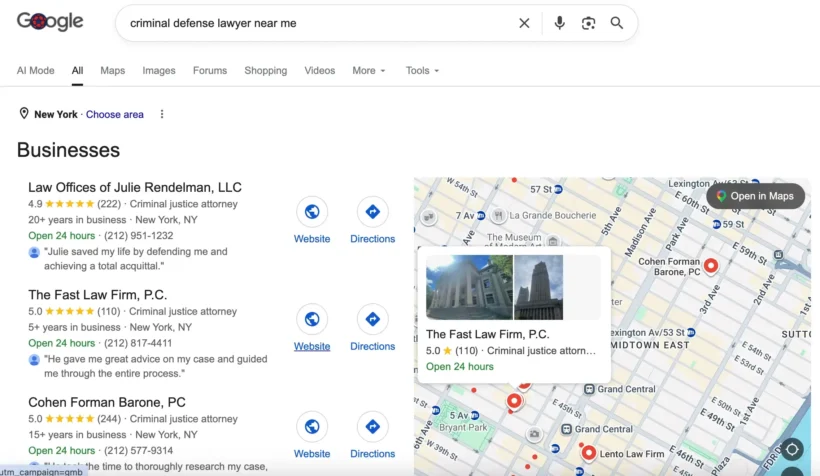
Digital marketing for criminal defense lawyers comes down to being visible in the hours after an arrest. That’s when people search, compare, and hire. Five channels do most of the work: a Google Business Profile that puts you in the Local Pack, a website built for panicked visitors, legal directory listings, paid search ads, and client reviews. Get those right, and you show up the moment someone types “criminal defense lawyer near me” into their phone.
Key Takeaways
- Defense clients hire fast, often the same day, so every channel must end in a phone call
- Your Google Business Profile decides whether you appear in the Local Pack for “near me” search results
- Listings on Avvo, Justia, and other legal directories bring high-intent visitors plus backlinks
- Google Ads and Local Services Ads bring cases now, while SEO builds over months
- Track cost per signed case, not clicks, before scaling any channel
What Is Criminal Defense Marketing?
Criminal lawyer marketing is the work of promoting a defense practice so people facing criminal charges can find it and trust it enough to call. It covers your law firm website, search visibility, directory profiles, advertising, and reputation.
One thing separates it from other legal marketing efforts: speed. A client looking for a personal injury lawyer might compare firms for weeks. A defense client got arrested Saturday night and has an arraignment Monday morning. They search from a phone, sometimes a borrowed one, and they hire whoever looks credible and answers first.
That urgency shapes every tactic below. A slow website, a buried phone number, or a voicemail box that fills up overnight all hand cases to the firm down the street.
Why Defense Firms Can’t Coast on Referrals
Referrals built plenty of defense practices, but they hit a ceiling in this field. A former DUI client rarely brings you up at dinner. People keep criminal cases private, and that silence chokes the word-of-mouth pipeline that feeds estate or family lawyers.
The search data confirms where clients actually go. The Clio Legal Trends Report found that 57% of legal consumers search online before hiring an attorney. Meanwhile, the American Bar Association’s TechReport shows 87% of law firms already have a website, so simply existing online isn’t an edge anymore.
If your firm is invisible in the hours after an arrest, the case goes to whoever isn’t.
How to Market a Criminal Defense Law Firm
Six steps, ordered by where most firms see the fastest return.
1. Build out your Google Business Profile
Search “criminal defense attorney” plus any city and Google shows three firms on a map before a single organic result. That’s the Local Pack, and your Google Business Profile decides whether you’re in it.
Fill in every field. Pick “Criminal justice attorney” as your primary category, list after-hours availability, add office photos, and create a service entry for each charge type you handle.
Keep your name, address, and phone number identical across the web. Inconsistent NAP details confuse Google and cost you map rankings.
2. Create a page for every charge type
DUI. Drug possession. Domestic violence. Assault. Theft. Each deserves its own page explaining the penalties in your state, what happens at each court stage, and how a lawyer changes the outcome.
These pages rank for the searches people actually type, like “first DUI offense penalties” with a city attached. They also convert well because they answer the exact question that brought the visitor in.
3. Design for a visitor in a panic
Your site has one job: produce a phone call from a stressed person.
- Put a click-to-call button at the top of every page, visible without scrolling
- Write in plain language; nobody parses legalese the night after an arrest
- Keep the contact form to three fields at most
- State your response time and honor it
Test the site on a cheap Android over mobile data, not just your office Wi-Fi. Many of these searches happen in a parking lot outside a county jail.
4. Claim your legal directory listings
Avvo, Justia, FindLaw, and Super Lawyers attract people who are comparing attorneys right now. Profiles there also pass backlinks to your site, which supports the rankings you’re building in steps 1 and 2.
Complete every profile with the same NAP, a professional photo, and your charge-type specialties. Niche options matter too; a listing in a criminal defense lawyer directory puts you in front of visitors filtered to your exact practice area. For a comparison of which platforms deserve a paid upgrade, see this rundown of the top legal directories.
5. Run ads for the cases you want now
Search engine optimization takes months. Google Ads puts you at the top of results this afternoon.
Bid on specific, high-intent phrases like “DUI lawyer free consultation” plus your city. Skip broad terms like “lawyer” or “legal help”; you’ll pay for clicks from people who need a divorce attorney. Send each ad to a landing page about that exact charge, not your homepage.
Google’s Local Services Ads work differently: they show your photo and review score above regular ads, and you pay per lead instead of per click. For defense firms in competitive metros, LSAs often deliver a lower cost per signed case than standard PPC.
6. Turn closed cases into reviews
Most people now treat online reviews the way they treat a friend’s recommendation, and review count feeds the Local Pack rankings from step 1.
Ask at the moment of relief, right after a dismissal or a favorable plea, and text the client a direct link to your Google review page. Respond to every review, good or bad. One caution: never confirm in a public reply that someone was a client. Privilege outlives the case.
Where Defense Firms Waste Marketing Money
I’ve watched firms burn budgets in the same four places: broad ad keywords nobody tracks, posting on five social platforms instead of doing one thing well, cheap backlink packages that trigger Google penalties, and website redesigns that copy a competitor instead of fixing conversion.
The fix for all of them is measurement. Use call-tracking numbers for each marketing channel and calculate cost per signed case, not cost per click. A channel that produces expensive clicks but cheap retainers is a winner; the reverse is a leak.
FAQ
How long does SEO take for a criminal defense firm?
Expect months, not weeks, and longer in a competitive metro. Run Google Ads or LSAs in the meantime so the pipeline doesn’t sit empty while rankings build.
Should I hire a marketing agency or do this myself?
A solo lawyer can handle the Google Business Profile, directories, and reviews in a few hours a month. Ads and SEO at scale usually justify outside help. Before signing anything, work through these questions to ask a law firm marketing agency so you don’t end up paying for vanity metrics.
Conclusion
Start with your Google Business Profile and a website that produces phone calls, then layer in directories, ads, and a review system. Measure cost per signed case and put next month’s budget where the retainers came from. If you haven’t claimed your directory presence yet, add your business listing and start collecting those visitors today.