Most businesses chase backlinks and ignore brand mentions. That’s a mistake. Every time your brand name appears online without a link, you’re still sending trust signals to Google. And one of the most reliable ways to build those signals at scale? Business directories.
Key Takeaways
- A brand mention is any reference to your company name online, linked or not
- Google treats unlinked mentions as “implied links” – a documented ranking signal since its 2014 patent
- Directories generate brand mentions across multiple trusted platforms simultaneously
- Consistent directory listings strengthen your entity profile, helping Google understand what your brand does and who it serves
- Unlinked mentions can be converted into backlinks with simple outreach, and directories make this easier
What Is a Brand Mention For SEO?
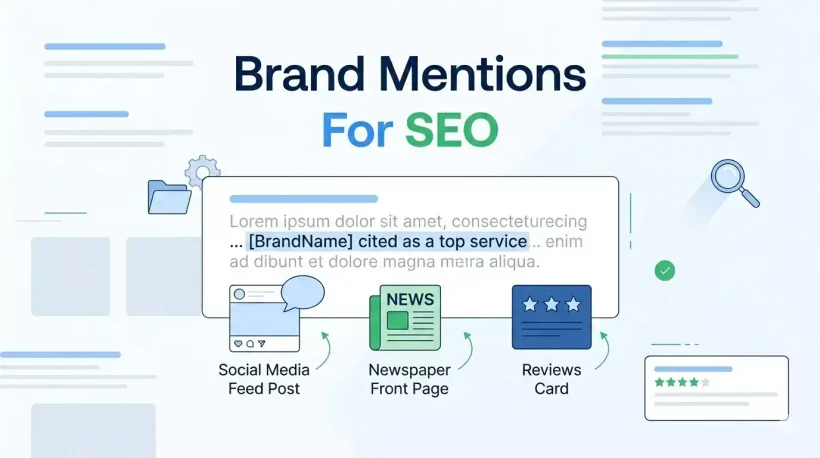
A brand mention is any time your business name appears on the web. That includes news articles, blog posts, review sites, forum threads, social media, and business directory listings.
There are two types:
- Linked mentions – your brand name is a clickable link pointing to your site (a traditional backlink)
- Unlinked mentions – your brand name appears in text, but without a hyperlink
Google’s 2014 “implied links” patent confirmed that search engines track brand references even when no link exists. The logic is simple: if your brand name appears frequently on credible, authoritative sites, that signals legitimacy. Google reads that pattern whether or not those mentions include a link.
This matters more than most SEOs give it credit for.
How Brand Mentions Impact Your Search Visibility
Brand mentions influence SEO through three mechanisms that work together over time.
Entity recognition. Google builds a knowledge graph of entities – businesses, people, places, concepts. When your brand is consistently mentioned alongside relevant industry terms and locations, Google learns what your business does and who it serves. This strengthens your entity profile and can trigger branded features in search results like knowledge panels and rich results.
Trust and authority signals. Mentions in high-authority sources tell Google your brand is real and relevant. A mention in a well-established directory carries weight, especially when that directory is regularly indexed and trusted by search engines. This is part of the broader set of off-page authority factors that go beyond link counting.
Co-citation patterns. When your brand appears repeatedly alongside competitor names or industry keywords – even without a link – Google maps those associations. It builds relevance for category-level searches you may never have targeted directly on your own pages.
“A brand mention in a trusted source is a vote of confidence in text form. Google has always been good at counting votes – it doesn’t need a hyperlink to register one.”
Why Business Directories Are a Brand Mention Machine
Here’s where most brand-mention guides miss something important: directories are among the most efficient ways to generate high-quality brand mentions at scale.
When you list your business on a reputable directory, several things happen at once:
- Your brand name appears on an indexed, trusted page
- Your business gets associated with relevant categories and keywords
- Your NAP data (name, address, phone) creates a consistent entity footprint
- Aggregator sites that pull from directories republish your listing, multiplying the mention count
A single well-optimized directory profile can generate brand mentions across multiple platforms without any additional effort. This is exactly why local citation building remains one of the most reliable early-stage SEO tactics for any business.
Beyond SEO signals, this also drives passive brand awareness. People searching for categories in a directory encounter your business name even when they weren’t specifically looking for you.
The critical factor is quality. Google distinguishes between mentions in spam directories with no editorial standards and mentions in established, category-specific directories with real traffic. A listing in a general business directory like OnToplist.com carries more weight than 50 entries in link farms, because the domain has genuine authority and a real audience.
Getting your business listings working for local SEO is not just about citations. It’s about placing your brand name in contexts where Google expects to find real, credible businesses.
Types of Brand Mentions That Carry the Most SEO Value
Not all mentions are equal. Prioritize these:
High-value mentions:
- Niche directory listings with category relevance (a law firm listed in a legal directory, not just a generic web directory)
- Editorial coverage in industry publications
- Review platform mentions on G2, Trustpilot, and Google Business Profile
- News articles and press features
- “Best of” or round-up posts from authoritative sites
Lower-value mentions:
- Mass-submitted spam directories with no traffic or editorial curation
- Automated content farms
- Uncontextual forum posts on low-authority sites
Brand sentiment matters too. Positive mentions on trusted review platforms strengthen your authority. Clusters of negative reviews, especially on high-visibility platforms, can correlate with ranking drops – particularly in local search where Google Business Profile data directly influences pack rankings.
How to Monitor and Track Brand Mentions
Set up monitoring before you start any outreach campaign.
Free tools:
- Google Alerts – set alerts for your brand name, common misspellings, and key people at your company
- Google Search Console – track branded query impressions over time to measure brand search growth
Paid tools:
- Ahrefs Content Explorer – filters for unlinked brand mentions and shows the domain authority of the source
- Semrush Brand Monitoring – tracks mentions across news, blogs, and social platforms
- Mention.com – real-time monitoring with sentiment tagging
Cover: exact business name, shortened variations, founder names, and product names. Check your monitoring data monthly and analyze by source quality, sentiment, and volume trends. The best SEO tools guide covers several of these in more detail.
Converting Unlinked Brand Mentions into Backlinks
This is the highest-ROI link-building tactic most businesses overlook. If a site already mentions your brand without a link, outreach is far warmer than cold prospecting. They already know who you are.
The process is straightforward:
- Export unlinked brand mentions from Ahrefs or Semrush, filtered by domain rating (DR 40+ is a good floor)
- Find contact details for the author or webmaster
- Send a short, direct email: point out the mention, and ask if they’d consider adding a link. Keep it to 3-4 sentences
- Follow up once after 5-7 days if there is no reply
Conversion rates for this outreach typically run 15-30%, compared to 2-5% for cold link requests. Directories accelerate this, too: aggregator sites that pull from established directories often republish listings without a link, making them prime outreach targets. Each one is a quick win.
This pairs naturally with a broader strategy focused on building quality backlinks through authority signals rather than volume.
Brand Mentions and AI Search Visibility
Google’s AI Overviews and AI-powered search tools increasingly use brand mentions as a signal when deciding which businesses to surface in generated answers. When search engines and AI systems compile recommendations, they draw from sources that consistently reference the same brand names in relevant, trustworthy contexts.
Businesses with strong brand mention profiles – consistent directory listings, positive reviews, editorial coverage, and accurate NAP data – are more likely to appear in these AI-generated responses. Brand visibility in AI search is not a separate discipline from traditional SEO. It’s the same authority signals, weighted for a different output format.
The brands that show up in AI Overviews are not there by accident. They built credibility over time through consistent mentions across multiple trusted sources. Directories are part of that foundation.
Conclusion
Brand mentions reward businesses that build a consistent, visible presence across trusted sources – not just those with the most backlinks. Start with solid directory listings to establish your entity footprint, then layer in outreach to convert unlinked mentions into links. That combination builds the kind of authority that holds up whether Google is running traditional algorithms or AI-generated answers.