Your company’s name, address, and phone number appear on dozens of sites you don’t control. When those listings don’t match, Google gets confused, AI assistants get confused, and your local rankings quietly slip. The good news is that this is one of the most fixable problems in SEO.
This guide covers what NAP consistency means today, why AI-driven search makes it more important than ever, and the exact steps to audit your citations and maintain consistency going forward.
Key Takeaways
- Your Name, Address, and Phone number must match identically everywhere they appear online, down to punctuation and suite numbers
- AI assistants and Google’s 2025 spam updates have raised the cost of inconsistent NAP information, making it a bigger factor in local SEO success than a year ago
- A quarterly citation audit plus LocalBusiness schema is the fastest way to maintain NAP consistency and protect local search rankings
What NAP Consistency Really Means
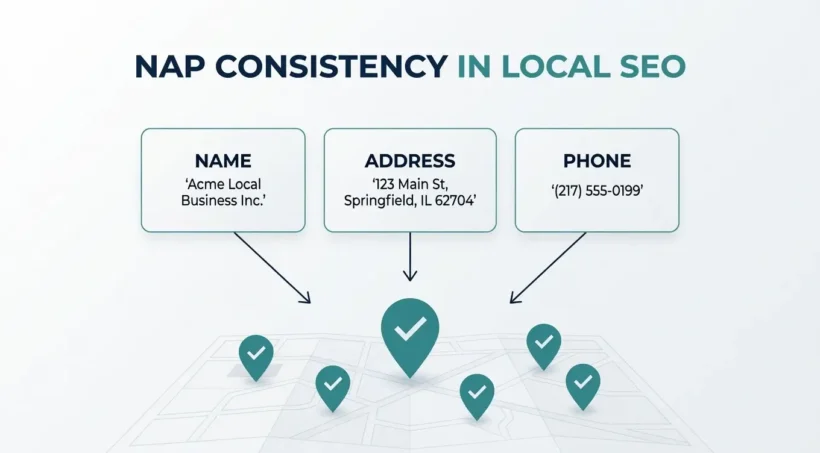
NAP consistency is the practice of displaying the same company name, address, and phone number across every online platform that lists you. That includes your website, local directories, social profiles, review sites, and map platforms.
The word that matters is identical. “123 Main St.” on your Google profile and “123 Main Street, Ste. 4” on Yelp look fine to a person. To a crawler matching records across sources, they’re two different addresses. Consistency across all sources is what turns those mentions into a single trusted record.
Consistent NAP data isn’t about being tidy. It’s about giving machines one clean answer to the question “is this the same business?”
Every matching citation strengthens the signal. Every mismatch weakens it.
Why It Matters More in 2026 Than Ever Before
Local search used to be a Google problem. In 2026, it’s also an AI problem.
When someone asks ChatGPT, Gemini, or Perplexity for “best lawyer near me,” those systems draw on the same citation graph that Google has been building for years. If one of your profiles shows a different contact number than another, the model has no reliable way to decide which one to surface, so it often picks a competitor with cleaner data.
Three recent shifts make this urgent:
- Google’s 2025 spam updates tightened enforcement against inconsistent profiles, keyword-stuffed names, and mismatched real-world details
- AI Overviews and voice assistants pull business data from aggregators, making clean source data a ranking factor across multiple surfaces
- Mobile searches often bypass traditional SERPs entirely, going straight from map pack to phone call, so an inconsistent phone number is a lost customer
Research from BrightLocal consistently shows that most consumers lose confidence in a business after spotting inconsistent contact details online. One study found 68% would stop using a local business if they found incorrect information in a directory. That’s a customer lost before they even call.
The Most Common Ways NAP Information Breaks
Inconsistencies don’t usually come from carelessness. They come from small operational changes that nobody tracks.
Business name drift. You registered as “Smith & Sons Plumbing LLC” but everyone calls you “Smith Plumbing.” Your Facebook page, Google listing, and Yelp profile all use slightly different versions. To a search engine, those might be three separate companies.
Address formatting variations. “Suite 100” vs “Ste 100” vs “#100.” “Street” vs “St.” Postal code with or without the +4 extension. Each variant reduces the confidence score.
Phone number formats. (555) 555-1234, 555.555.1234, and +1-555-555-1234 should all be read as the same number. They usually are, but not always, especially on older directories.
Stale data from a move. You relocated in 2023. Two years later, your old address still lives on 20 smaller directories because aggregators keep syndicating the outdated record. This is the single most common cause of local search ranking decline.
Tracking phone numbers. Running a CallRail campaign? If the tracking number replaces your real phone number in one listing, you’ve just created an inconsistent NAP citation.
How to Audit Your NAP (A Practical 5-Step Process)
You can’t fix what you can’t see. Start here.
Step 1: Write Your Master NAP Record
Open a document and record your business name, full address, and primary phone number in the exact format you want to see everywhere. This is your single source of truth. Share it with your team, your agency, and anyone who might create a listing on your behalf.
Step 2: Run Manual Searches
Google your company name in quotation marks. Also, search your phone number and address separately. Check the first three pages of results. You’ll almost always find listings you forgot existed.
Step 3: Prioritize the High-Impact Platforms
Not all directories carry equal weight. Focus here first:
- Your Google profile (formerly Google My Business)
- Bing Places
- Apple Maps
- Yelp
- Industry-specific directories (legal, medical, home services, etc.)
- Your own website (header, footer, contact page, schema markup)
A small number of trusted directories influence hundreds of smaller ones through data syndication.
Step 4: Check the Data Aggregators
Platforms like Data Axle and Foursquare feed business data to a long tail of smaller sites. One wrong record here can spread to dozens of other directories within weeks. Fix the source, and most of your downstream local listings correct themselves over time.
Step 5: Use a Citation Management Tool
Manual audits work for a single location. For multi-location businesses or larger operations, tools like Moz Local, BrightLocal, Semrush Listing Management, or Yext scan dozens of sites in minutes and flag every mismatch.
Fixing Inconsistencies in the Right Order
Cleaning up your listings is straightforward once you have the audit data. Work top-down.
Fix your website first. NAP in the footer so it appears on every page. NAP on the contact page. Most importantly: add LocalBusiness schema markup so machines can parse your data directly. Schema is the fastest way to hand AI systems a clean answer.
Update the Google Business Profile next. It’s the single most influential listing you have. Verify every field, remove duplicate profiles, and make sure your category and service areas are accurate.
Then work through major directories. Claim unclaimed listings. Update or delete old profiles. Merge duplicates. A local citation you don’t control is a citation you can’t fix.
Clean up social media. Facebook, LinkedIn, and Instagram all contain business profile data that Google can read.
Once your core listings are clean, invest in building citations on trusted directories where your business isn’t yet listed. Each new citation that uses your master NAP strengthens the consistency signal.
Keeping NAP Consistency Going Forward
The hardest part isn’t fixing the mess. It’s keeping it clean.
Build these four habits into your workflow:
- Quarterly spot-checks. Every 90 days, verify your top 10 listings. A calendar reminder is enough.
- A change-management rule. Maintaining NAP accuracy means that whenever you change your company name, address, or phone number, all listings are updated within 48 hours. Start with your Google profile, then cascade outward.
- Ownership of every profile. Claim anything with your business on it, even small niche sites. Unclaimed listings are the ones that go stale.
- A single internal owner. One person, not a committee, should own NAP accuracy. Usually marketing or operations.
If you pair consistent NAP data with a fully optimized Google Business Profile, you’ve covered the two most impactful pieces of any local SEO efforts. Most of your competitors haven’t.
FAQ
Does NAP formatting really matter, or just the information itself?
Formatting matters. Modern search engines are better at recognizing variations, but inconsistencies still lower confidence scores. Use the exact same format everywhere, including abbreviations, punctuation, and suite numbers.
How often should I audit my NAP listings?
At least once per quarter. Also, run an audit immediately after any change to your business name, address, or phone number. Aggregators can propagate old data for months if you don’t catch it early.
What’s the single fastest NAP fix I can make?
Add LocalBusiness schema markup to your website and verify every field on your Google listing. Those two actions give AI systems and Google a clean authoritative source for your NAP information, which makes small inconsistencies on other sites less damaging.
Conclusion
NAP consistency is the cheapest, highest-impact local SEO investment you can make. Write your master NAP, audit your listings, fix the mismatches, and build a quarterly habit. Do that, and you’ll out-rank competitors who are still treating their business data like an afterthought.