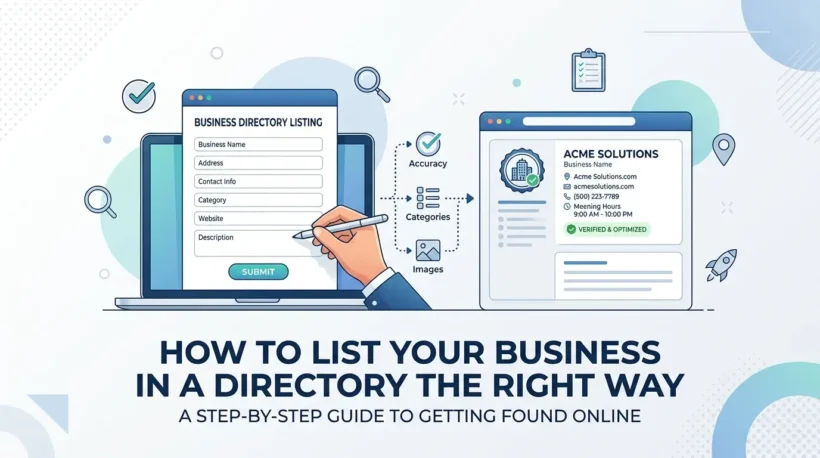
Listing your business the right way starts with claiming your profile, completing every field, and choosing the category that best matches what you do. Most importantly, use the exact same business name, address, and phone number on every site.
The accuracy part trips up most business owners. A listing with an old phone number or the wrong suite can hurt you more than having no listing at all. Research from BrightLocal found that for informational local searches, business directories fill roughly 37% of the organic results. That is a lot of visibility sitting there for any business willing to get listed properly.
A half-finished listing won’t sink you. A wrong one will.
Key takeaways
- Use one exact version of your name, address, and phone number on every site.
- Claim your Google Business Profile first, then expand to Yelp, Yellow Pages, and niche directories.
- Fill in every field before you publish, including hours, services, and a real description.
- Inconsistent business information confuses search engines and pushes potential customers elsewhere.
The step-by-step process
Here is the order that works, from the listing that matters most down to the niche ones that round out your online presence.
- Check for listings that already exist. Many directories auto-generate a profile from public data before you ever sign up, often with an old address or a number that rings nowhere. Search your business name on Google, Yelp, and a few directories. If a profile is already there, claim it rather than creating a duplicate. Two listings for the same business split your reviews and confuse search engines.
- Lock down your NAP. NAP means name, address, and phone number. Pick one exact version, down to whether you write “Street” or “St.”, and use it everywhere. A search engine reads “Suite 200” and “Ste 200” as two different places, and that mismatch can quietly drag down your ranking. This guide breaks down how to keep your NAP consistent.
- Claim your Google Business Profile. It feeds both Google Search and Google Maps, where most local search activity happens. Verify ownership, set your primary category, and add your service area. A few more wins are worth knowing when you’re optimizing your Google Business Profile.
- Add the big general directories. Yelp, Yellow Pages, Bing Places, and Facebook reach a wide audience and send trust signals to Google. Use the same NAP and description on each one.
- Complete every field. Include hours, categories, payment methods, a website, and a clear business description. A profile with blank sections looks abandoned to customers and search engines alike, so take a minute to write a strong business description that says what you actually do.
- Upload real photos. Add your logo, storefront, team, and a few shots of your work. Aim for at least five clear, well-lit images, and avoid stock photos. Listings with photos pull more clicks than bare ones, and they make your business look open and active.
- List in niche and local directories. Add a couple of industry sites and a solid local business directory for your city. When you’re ready, you can list your business on OnToplist in a few minutes.
Once those are live, the work shifts to upkeep. Update your hours around holidays, swap in fresh photos occasionally, and reply to customer reviews as they come in.
Where to list your business
Not every directory deserves your time. Spreading yourself across hundreds of low-quality sites does little, and a few can even drag down your SEO. Aim for quality and relevance instead.
Three buckets cover almost everyone:
- Major search and map platforms like Google Business Profile, Bing Places, and Apple Maps, which shape what shows up in local search results.
- Trusted general directories such as Yelp, Yellow Pages, Facebook, and the Better Business Bureau.
- Niche and local directories: industry sites and city directories where your customers already look.
If you’re weighing whether to pay for placement, it helps to understand the difference between free and paid directories before spending anything. A good free listing on a relevant site usually beats a paid spot on one nobody visits.
Mistakes that get your listing buried
Plenty of business owners do the work and still see nothing. It usually comes down to a few avoidable errors.
- Inconsistent NAP across sites. This is the big one. Even small differences split your signals.
- A wrong or vague category. Pick “contractor” when you’re a plumber, and you miss the searches that matter.
- Keyword-stuffing your business name. Tacking “Best Cheap Plumber Chicago” onto your name breaks Google’s own guidelines and can get you suspended.
- Ignoring customer reviews. A low rating and no replies send people straight to a competitor.
- Setting it and forgetting it. Outdated hours frustrate the exact people you worked to attract, and wrong information will stop most of them cold.
Most listing failures aren’t about effort. They’re about accuracy and follow-through.
FAQ
What information do I need before I start?
Have your exact business name, address, phone number, website, hours, and primary category ready in one document. Add a short and a long description, your logo, and a few photos. With everything in one place, you can fill in each listing in minutes and keep the details identical.
How long does it take for a directory listing to help my ranking?
Expect a few weeks to a few months. Search engines need time to find, verify, and trust new business information, and consistent details across sites speed that up.
Should I pay for directory listings?
Not at first. Claim the free, high-value listings, get your details consistent, and gather reviews. Pay only when a specific directory clearly reaches your customers and the free version holds you back.
How many directories should I get my business listed in?
There’s no magic number. Cover the major platforms, a handful of trusted general directories, and the niche or local directories tied to your industry. Ten accurate listings beat fifty sloppy ones.
Conclusion
Getting your business listed the right way is less about volume and more about accuracy: one consistent NAP, complete profiles, and steady upkeep. Start with your Google Business Profile today, then add the directories your customers actually use, and keep every listing up to date.