Business directories and your Google Business Profile do different jobs, so you need both. Your Business Profile controls how you appear inside Google Search and Maps. Directories carry your business data elsewhere, including AI assistants and the industry sites buyers check before calling. One is your storefront on Google. The rest is your evidence off it.
Key Takeaways
- Claim and complete your Google Business Profile first. Nothing else in local search pays back as fast.
- New directory listings won’t lift your Map Pack position. Expert surveys rank citation volume near the bottom for local pack impact.
- Fix the listings you already have before adding more. Consistency scores far higher than count.
- Directories now do a job your Business Profile can’t do at all: feeding the AI tools people ask for recommendations.
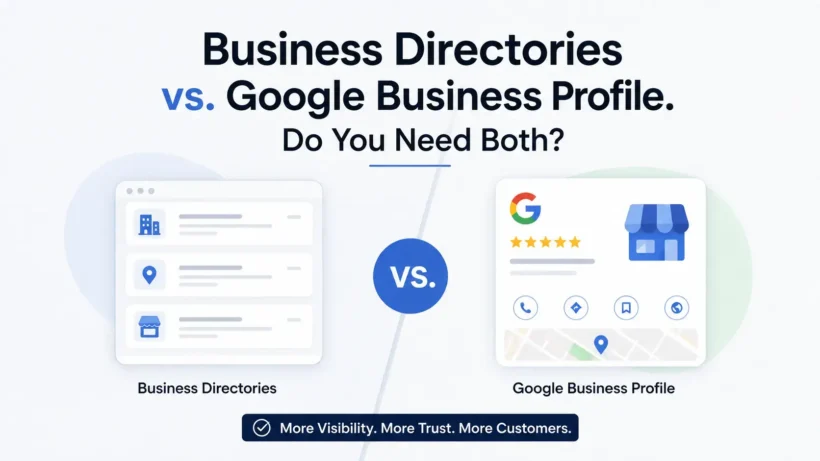
Business Directories vs. Google Business Profile: What Each One Actually Does
Google Business Profile is the free listing that puts you in Google Search, Google Maps, and the three-result local pack sitting above organic results. It holds your hours, categories, photos, services, and Google reviews. On a phone, someone can call you directly without ever visiting your website. That immediacy is why optimizing your Business Profile is the first thing worth doing.
A business directory is an independent site that organizes companies by category, city, or industry. Some are general, like Yelp, Apple Maps, and Bing Places. Some are niche: Avvo for lawyers, Healthgrades for doctors, G2 for software.
Each directory listing does two things at once. It puts you in front of people browsing that site, and it publishes a structured copy of your name, address, and phone number that other systems read later.
| Google Business Profile | Business directories | |
|---|---|---|
| Where you appear | Google Search, Maps, local pack | The directory itself, plus organic results and AI answers |
| Who controls it | You submit, the directory publishes, and the copy lives outside Google | |
| Links to your site | None | Yes, from moderated directories |
| Reviews | Google reviews only | Platform reviews, often niche-specific |
| Cost | Free | Free to paid |
| Speed | Weeks | Slow and compounding |
| Main risk | Suspension, competitor edits | Low-quality sites, stale data |
The overlap between those two columns is small. That’s the entire argument for running both.
Do Directory Listings Help Your Google Rankings?
Not the way most people hope.
Google describes local results as a mix of relevance, distance, and prominence, and says prominence is partly based on how many websites link to your business and how many reviews you have. Directory listings feed that pool. They are not a lever you pull.
The expert data is blunter. Whitespark’s 2026 Local Search Ranking Factors report asked 47 local SEO specialists to score 187 factors. The quantity of structured citations landed at #110 for local pack impact. Consistency of citations across Google Maps, Bing Maps, and Apple Maps landed at #28.
Read those two numbers together. Your fortieth listing does almost nothing for your Map Pack position. Getting the phone number identical across the twelve listings you already have does considerably more, which is why NAP consistency keeps outranking volume in every survey.
Directory listings won’t push your Map Pack position up. Bad directory data can hold it down.
There are two places where listings genuinely carry weight. The first is local organic results, where links from moderated directories count toward domain authority, a factor the same survey ranks in the top five. The second is AI answers. Three of the top five AI search visibility factors in the 2026 report are citation factors, and Darren Shaw’s summary of the finding is worth borrowing: in AI SEO, mentions are the new link. If you want the mechanics, we covered how directory listings surface in AI results separately.
What Happens the Week Your Google Business Profile Goes Dark
Your Business Profile isn’t really yours. Any Google user can report it. Strangers can suggest edits to your category, hours, or address. Sterling Sky, which runs a reinstatement practice full-time, typically resolves appeals in one to six weeks.
Picture that week. The calls stop. The map pin is gone. You’re filing paperwork with a company that won’t tell you what you did wrong.
Now picture it with twelve live directory listings. Buyers still find you on the industry site they were browsing anyway. The AI assistant still has a source to pull from. Your business details still exist, correctly, in a dozen places Google itself reads when it rebuilds its picture of who you are.
Running a directory, I constantly see the aftermath of this. Businesses show up submitting listings during a crisis, and the same company arrives with three different phone numbers across three submissions, because nobody ever wrote down which one was official. Redundancy is cheap in advance and expensive on the day you need it.
Which Directories Earn a Slot, and How Many
Aim for 10 to 20 relevant listings, then stop counting and start maintaining. We’ve broken down how many listings a business actually needs with the numbers behind that range.
Run each candidate through four filters:
- Does a human review submissions before they publish?
- Do real people browse it, or is every page built for crawlers?
- Is it specific to your industry or your city?
- Does it rank for its own category terms when you search for them?
A directory that fails two of those isn’t worth an afternoon. Our fuller guide to picking directories that are worth your time covers the edge cases.
Order matters more than volume. Business Profile first, then Bing Places and Apple Maps, then a moderated general option such as a vetted US business directory, then the two or three niche sites where buyers in your sector actually make decisions.
When a Directory Listing Isn’t Worth It
Skip it when nobody moderates submissions, because a site that publishes anything instantly is publishing your competitors’ spam too.
Skip it when the fee buys a link and nothing else. Some paid listings earn their keep through referral traffic, and the free versus paid breakdown sorts out which is which.
Skip it when you can’t edit the listing later. Businesses move, rebrand, and change numbers. A listing you can’t correct becomes a permanent inconsistency working against you.
Skip it when the site demands a reciprocal link, and skip it when its category pages don’t rank for anything.
One case deserves special mention: a listing with wrong details that you’ve lost access to is worse than no listing at all. Find those, fix them, and only then go build new ones.
Frequently Asked Questions
Is Google Business Profile a directory?
Functionally, it behaves like one, since it collects and displays business listings. Practically, it’s different because it lives inside Google’s search results rather than on a site people visit deliberately. Nobody browses Google Business Profile. They browse Yelp.
Do I still need directory listings if Google My Business profile ranks first?
Yes, for two reasons that have nothing to do with rankings. Your top spot lasts exactly as long as Google lets it, and a growing share of buyers now start with an AI assistant that reads directory data rather than Map Pack results.
How long before directory listings do anything?
Referral clicks can arrive within days on a directory people actually use. The data effects, meaning consistency and AI visibility, take months and compound quietly. Neither shows up as a spike in your analytics, which is why so many owners conclude nothing happened.
Conclusion
Business Profile on Google wins you the moment someone searches. Directories win you everything before and after that moment. Claim the profile, complete it properly, then build a short list of moderated directories and keep every detail identical across them. That’s a weekend of work that keeps paying while you sleep.